

Tip Calculator
Calculate tip amount and split the bill among any number of people.
About
Tip Calculator
Two calculators sit above this. The first takes the price of the service and shows the tip and the total at ten common percentages at once, so you can see what the difference between 15% and 20% actually costs before you decide. The second splits a bill between any number of people and gives the tip and the total each person owes.
How a tip is worked out
A tip is a percentage of the price, added on top. Multiply the price by the percentage and divide by 100, then add it to the bill. On a $55 meal, 15% is $8.25 and the total is $63.25.
You rarely need a calculator for it, and the trick is worth knowing for when your phone is in your pocket. Move the decimal point one place left to get 10%: on $55 that is $5.50. Half of that is 5%, so $2.75. Add them for 15%, or $8.25. Double the 10% for 20%, or $11.00. Everything else is a nudge from those three numbers.
Before tax or after tax
The convention in the United States is to tip on the price before sales tax, which is what these calculators use. Tax is money the restaurant collects for the state, and the server had nothing to do with it.
Plenty of card terminals suggest percentages of the post-tax total instead, and the gap is small but real. On that $55 meal with 8% tax, tipping 20% on the after-tax figure of $59.40 costs $11.88 rather than $11.00. It is 88 cents once and a few hundred dollars a year if you eat out often. Nobody will mind either way, but the pre-tax number is the one the custom is built on.
Tipping around the world
Tipping is a local custom rather than a rule, and the customs differ so widely that the polite thing in one country is an insult in another. In Japan tipping can cause genuine discomfort and is sometimes read as suggesting the staff are underpaid. Across much of continental Europe service is already included and rounding up the bill is enough. In the United States tipping is expected, widely relied on, and in most states forms part of how a server is paid at all.
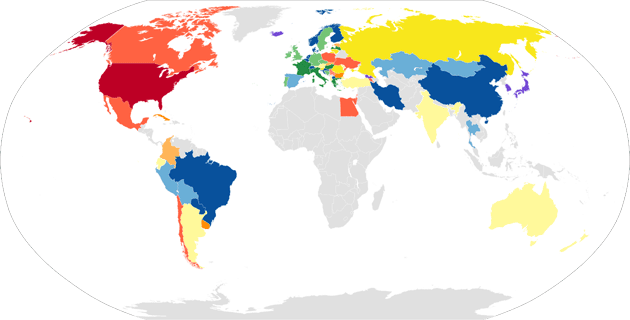
Two things follow from that map. If you are travelling, check before you go, because generosity is not universally read as generosity. And if you are in a country where tipping is expected, treat it as part of the price rather than as a bonus, because that is how the wage structure treats it.
Why tipping carries so much weight in the United States
Federal law lets an employer pay a tipped worker a cash wage as low as $2.13 an hour, taking a tip credit of up to $5.12 to reach the $7.25 federal minimum. If tips fall short, the employer has to make up the difference, but the practical effect is that a server's income is mostly tips rather than wages.
Several states, California, Oregon, Washington, Nevada, Alaska, Minnesota and Montana among them, require the full state minimum wage before tips, which is why tipping norms feel different across state lines. It is still customary in those states; the stakes for the worker are simply lower.
Where the custom came from
Tipping is not native to the United States. It arrived from Europe in the middle of the nineteenth century, carried home by wealthy Americans who had picked it up abroad, and it spread fastest in industries that hired workers they could pay least.
It was resisted hard. Critics argued it was undemocratic, an imported aristocratic habit that made service into servility, and between 1909 and 1915 six states passed laws against it outright, among them Washington, Iowa, Arkansas, Tennessee, Mississippi and South Carolina. Every one of those laws was gone by the mid 1920s, repealed or struck down, and the practice settled in permanently. The tipped wage that exists in federal law today is the long tail of that argument, which is why tipping in America carries a weight it does not carry elsewhere.
The card terminal problem
Handheld terminals changed tipping more in a decade than the previous century did. Presented with three buttons and somebody waiting, most people take the middle one, and the suggested percentages have been drifting upward. Prompts starting at 20% are now routine, and they frequently calculate from the post-tax total.
The prompts have also spread to counters where nobody has served a table, which is the part people find hardest to judge. There is no settled custom for a screen swivelled around after a two-minute transaction. The practical answer is to decide what the service was worth before the screen appears, and to remember that the custom button is always there, usually smaller and greyer than the rest.
Typical tips in the United States and Canada
| Service | Typical tip |
|---|---|
| Restaurants, bartenders | 15% to 20% |
| Food delivery | 15% to 20%, more for a long trip or bad weather |
| Hotel room service | Usually already on the bill. If not, 15% to 20% |
| Hotel housekeeping | Not expected, $1 to $2 per person per night |
| Automotive services, mechanic | Not expected, or a few dollars |
| Movers, furniture or appliance delivery | Not expected, or $5, $10 or $20 each |
| Plumber, handyman, electrician, cleaner | Not expected, or $5, $10 or $20 each |
| Hairstylist, barber, nail technician | 10% to 20% |
| Massage | 10% to 20% |
| Taxi or limo drivers | 15% to 20% |
| Shuttle drivers, parking attendant | $1 to $3 |
| Tour guides | $1 to $5 depending on the length of the tour |
The pattern behind the table is worth noticing. Percentages apply where the bill scales with the service, such as a meal or a haircut. Flat amounts apply where it does not, since a porter carries the same bag whether the room costs $90 or $900.
Splitting the bill
The shared bill calculator divides the total including the tip, not the price alone, which is what you want when everyone is paying an equal share. Three people splitting that $63.25 pay $21.08 each, of which $2.75 is tip.
Cents rarely divide cleanly, and the calculator says so when they do not. Three times $21.08 is $63.24, a penny short of the bill, so somebody covers the difference or everyone rounds up. Rounding up per person is the usual answer, and it quietly raises the tip, which is generally the intention.
Where people ordered very differently, splitting evenly is the wrong tool. Work out each person's share of the food, then apply the same tip percentage to each share. The tip percentage stays constant; only the base changes. And when a coupon or a discount is involved, tip on what the meal would have cost before the discount, since the work of serving it was the same.
Service charges and automatic gratuity
Restaurants often add gratuity automatically for larger parties, typically 18% to 20% for six or more. Read the bill before you add anything: paying a tip on top of an automatic one is a common and expensive mistake, and the line is easy to miss because it usually appears above the total rather than beside it.
A service charge is not the same as a tip. It is revenue for the business, and how much of it reaches staff varies by venue and by jurisdiction. If a bill already carries one and you want the money to reach the person who served you, cash in their hand is the reliable route.
Reading your result
The table exists so you can see the whole range at once. The gap between 15% and 20% on a $55 bill is $2.75. On a $200 dinner it is $10. Whether that matters is your call, but it is easier to make when the numbers are side by side rather than one at a time.
Use the rounded up figure when you are paying cash and want to skip the change, and remember that rounding up a per-person share is a tip increase rather than a rounding error. To work out a percentage of any other number, use the Percent Calculator, and to check the tax portion of a bill before you tip on the rest, the Sales Tax Calculator separates the two.
Common questions
Frequently asked questions
In the United States, 15% of the pre-tax bill is the long-standing baseline and 18% to 20% is now common for table service. On a $55 meal that is $8.25 at 15% and $11.00 at 20%.
Before tax is the convention, and it is what these calculators use. Sales tax goes to the state rather than to the restaurant, so the server had no part in it. On a $55 meal with 8% tax, tipping 20% after tax costs 88 cents more.
Move the decimal one place left for 10%, halve that for 5%, and add them. On $55 that is $5.50 plus $2.75, so $8.25. Doubling the 10% figure gives you 20%.
Add the tip to the price first, then divide by the number of people. A $55 bill with a 15% tip is $63.25, which is $21.08 each between three people. If the cents do not divide evenly, everyone rounds up or one person covers the difference.
Usually not. Automatic gratuity of 18% to 20% is common for parties of six or more, and adding a second tip on top is a frequent mistake. Check the bill before you sign, since the line often sits above the total rather than next to it.
It varies enormously. In Japan it can cause discomfort, across much of continental Europe service is included and rounding up is enough, and in parts of Latin America and the Middle East 10% to 15% is the norm. The map above shows the pattern by region.
Delivery and taxis run 15% to 20%, hairstylists and massage 10% to 20%, and hotel housekeeping is usually a flat $1 to $2 per person per night rather than a percentage. Flat amounts apply where the bill does not scale with the work.
Before. If a coupon takes $20 off a $70 meal, tip on the $70, because the work of serving it was the same. The discount is between you and the restaurant rather than between you and the server.
Method
How this is worked out
Built and checked by Calculator Castle. Last reviewed . Spotted something wrong? Tell us and it gets fixed.