

Time Zone Calculator
Convert times between different time zones around the world.
About
Time Zone Calculator
A time zone is a region of the Earth that keeps one uniform time. Zones usually follow the boundaries of countries or lines of longitude rather than the geometry of the planet, because clocks exist for the convenience of the people using them.
Greenwich Mean Time (GMT) is the mean solar time at the Royal Observatory in Greenwich, London, taken to sit at a longitude of zero degrees. GMT and Coordinated Universal Time (UTC) show essentially the same time, but they are different kinds of thing: GMT is a time zone, while UTC is a time standard used as the basis for civil time and for time zones worldwide. GMT was once the standard and is now mainly used as the time zone of certain countries in Africa and Western Europe. UTC, based on highly precise atomic clocks along with the Earth's rotation, is the reference in use today.
UTC does not shift with daylight saving time, though many countries move between offsets during their DST period. The United Kingdom, for instance, uses GMT in winter and British Summer Time in summer, so the country changes offset twice a year while UTC itself never moves.
Most land time zones are expressed as an offset from UTC. UTC breaks time into days, hours, minutes and seconds, with days defined by the Gregorian calendar, and zones are written as plus or minus a number of hours relative to it: UTC-05:00, UTC+08:00 and so on. Offsets range from UTC-12:00 to UTC+14:00, a spread of 26 hours, which is why two places on Earth can be on different calendar dates at the same instant. Most offsets are whole hours, but some are half-hours or quarter-hours, such as UTC+06:30 in Myanmar and UTC+12:45 in the Chatham Islands.
World time zone map
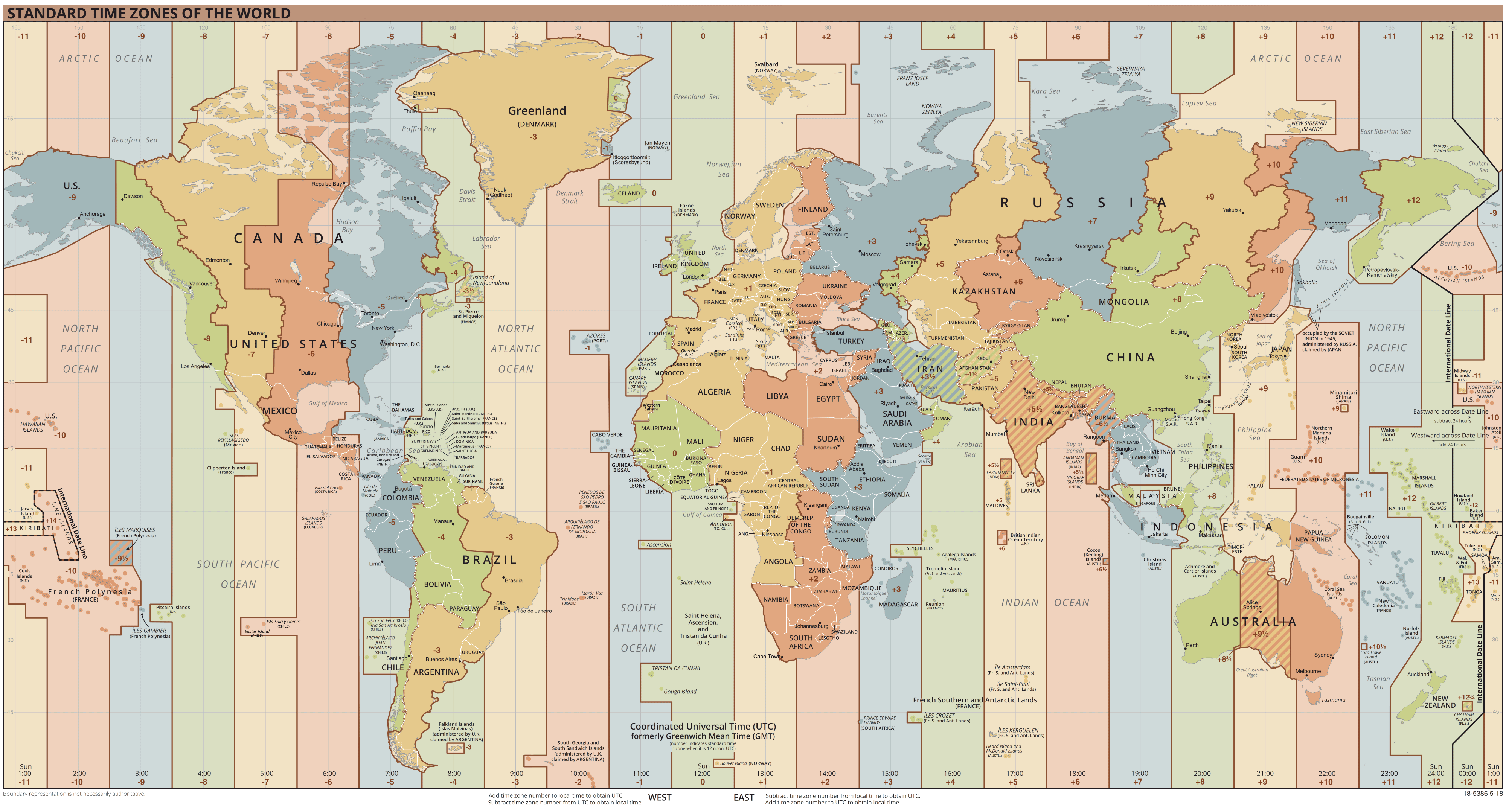
Time zones vary across the world and used to vary far more than they do now. It was not until 1929 that most countries had adopted hourly time zones. Nepal, the final holdout, did not adopt a standard offset until 1956, and even then settled on the unusual UTC+05:45.
The interactive map at the top of this page shows the same thing: scroll over it to zoom in far enough to read individual country labels and the offsets marked along the top and bottom edges.
As a general rule a change of 1 hour accompanies each 15° of longitude, since the Earth turns 360° in 24 hours. It does not always work out that way. China and India each use a single time zone despite spanning far more than 15° of longitude, which means the sun rises in western China several hours after the clocks say morning. Russia sits at the other extreme with 11 zones, briefly reduced to 9 between 2010 and 2014 before being restored. The standard exists, but its application remains a matter for each country and is subject to change.
The current system was proposed by the Canadian engineer Sandford Fleming in the 1870s and formalised at the International Meridian Conference in Washington in 1884, which adopted Greenwich as the prime meridian. The pressure for it came from railways: before standard time, every town kept its own solar clock, and a timetable across several towns was close to unusable. Britain's railways had already imposed a single "railway time" from 1840 for exactly that reason.
Two edges of the map are worth knowing. Kiribati moved its Line Islands to UTC+14 in 1995 so the whole country would share one calendar date, making it the first place on Earth to see each new year. Samoa did something similar in 2011, skipping 30 December entirely to jump from one side of the date line to the other and share a working week with its trading partners in Australia and New Zealand.
US time zone map
Many countries have more than one time zone. In the United States there are nine in total, of which the four best known cover most of the contiguous states.
- Eastern Time (ET), UTC-05:00: 22 states in the eastern part of the contiguous US, along with parts of Canada, Mexico, Panama and the Caribbean.
- Central Time (CT), UTC-06:00: parts of Canada, the US, Mexico, Central America, some Caribbean islands and part of the eastern Pacific. Only 9 states sit fully inside it; eleven more are split with the Mountain or Eastern zones.
- Mountain Time (MT), UTC-07:00: parts of Canada and Mexico plus 5 states fully within the zone; ten more are shared with the Pacific or Central zones.
- Pacific Time (PT), UTC-08:00: parts of Canada, the western US and western Mexico. California and Washington sit fully within it, three states are split with Mountain Time, and Alaska is split between Pacific and Alaska Time.
The Atlantic, Alaska, Hawaii-Aleutian, Samoa and Chamorro zones cover the rest of the country, including Alaska, Hawaii and the US territories, spanning UTC-04:00 through UTC+10:00.
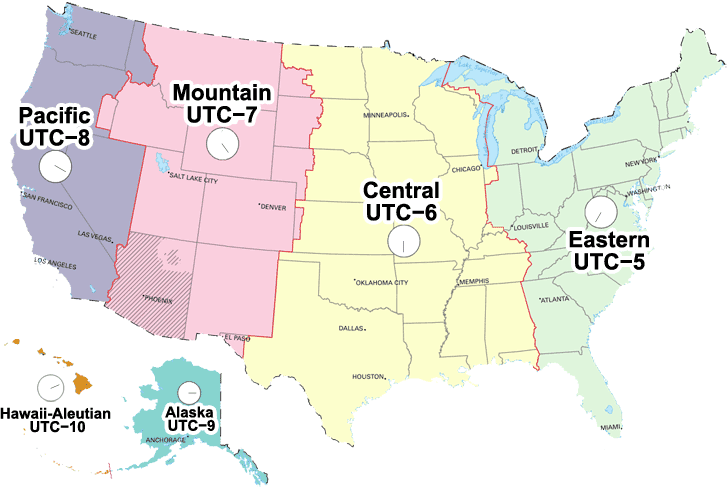
Regions that observe daylight saving shift one hour closer to UTC for part of the year. The ones that do not include Hawaii, most of Arizona, and the Atlantic, Samoa and Chamorro zones. Arizona is the interesting case: the Navajo Nation within it does observe DST, while the surrounding state does not, which leaves a patch of the map an hour out of step with its neighbours for half the year.
Daylight saving time
Many countries, especially in Europe and North America, practise daylight saving time, sometimes called summer time, with the intent of saving energy. It involves advancing clocks by one hour in early spring and rolling them back in autumn. Shifting the clock as the seasons change can align working hours better with daylight in some places. It matters far less near the equator, where day length barely varies, and at high latitudes, where sunrise and sunset are extreme regardless of what the clock says.
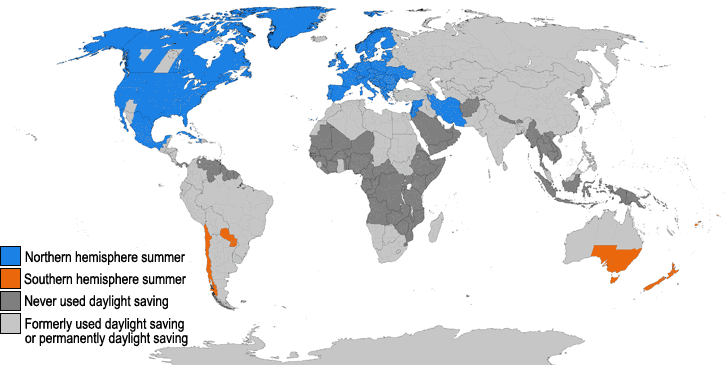
Germany and Austria-Hungary were first to adopt it nationally, on 30 April 1916, as a wartime fuel-saving measure, and other countries followed within months. The idea is often attributed to Benjamin Franklin, but his 1784 essay suggesting Parisians rise earlier was satire and proposed no clock change at all. In the United States the pattern was chaotic enough that Congress passed the Uniform Time Act in 1966 to standardise the start and end dates.
Whether it still achieves anything is genuinely contested. Modern studies find energy savings close to zero, since lighting is now a small share of household consumption and heating and cooling can move the other way. The European Parliament voted in 2019 to abolish seasonal clock changes, though member states have not agreed on which time to keep, so the changes continue. Fewer than half of the world's countries now use DST at all.
This calculator does not apply daylight saving. The offsets in the two menus are standard time, so a conversion involving a region currently on summer time needs an hour added by hand. That is a deliberate choice rather than a shortcut: applying DST correctly requires knowing the exact rule in force in that region on that date, and those rules change by act of parliament, sometimes at short notice.
How the conversion works
Every conversion runs through UTC. The source local time minus its offset gives the instant in UTC, and adding the destination offset gives local time there. The practical shortcut is simply the difference between the two offsets: converting from UTC-12:00 to UTC-09:00 moves the clock forward 3 hours, because the destination is 3 hours closer to UTC.
The part worth watching is the calendar date. When the shift pushes past midnight, the date moves with it, which is why the result here always names the day of the week as well as the date. Converting between distant zones routinely lands you on a different day, and that is the source of most missed meetings.
Software handles this differently from the way the menus above do. Programs use the IANA time zone database, which stores regions such as America/New_York rather than fixed offsets, precisely because a region's offset changes with the season and with legislation. The database records every historical change, which is how software can correctly convert a timestamp from 1975. If you are storing times in an application, store UTC and convert on display; storing local times is the single most reliable way to create bugs that surface twice a year.
One more detail behind UTC itself. It is kept in step with the Earth's rotation by leap seconds, occasionally added because the planet's spin is slightly irregular. In November 2022 the General Conference on Weights and Measures resolved to stop adding them by 2035, since they cause more trouble for computer systems than the drift they correct.
Common questions
Frequently asked questions
GMT is a time zone, kept by several countries in Western Europe and Africa. UTC is a time standard, based on atomic clocks, that every other zone is defined against. They show effectively the same time, so the two get used interchangeably in conversation, but only UTC is the reference point offsets are measured from.
No. The offsets in both menus are standard time, so if either location is currently observing summer time you need to add an hour yourself. Applying DST correctly requires knowing which rule was in force in that region on that specific date, and those rules are changed by legislation, sometimes at short notice.
Because zones follow political and practical boundaries, not clean 15° slices of longitude. India uses UTC+05:30 to keep one clock across a country spanning nearly 30°, Iran uses UTC+03:30, and Nepal uses UTC+05:45, a quarter-hour offset chosen so its time relates to a local peak rather than to India. The Chatham Islands use UTC+12:45.
Offsets run from UTC-12:00 to UTC+14:00, which is 26 hours of spread rather than 24, because some countries deliberately sit past the natural edge to share a calendar date. That means there are always at least two, and sometimes three, different dates in progress somewhere on Earth at any given moment.
Because the shift crossed midnight. A conversion of more than a few hours frequently changes the date, and between the far edges of the map it can change by a full day. The result above always shows the day of the week alongside the date so this is visible rather than assumed.
A political decision made in 1949 to unify the country on Beijing time, UTC+08:00, despite the territory spanning about five natural zones. In practice the far west runs several hours out of step with the sun, and Xinjiang informally keeps a second unofficial clock two hours behind the national one.
The line, roughly following 180° longitude, where the calendar date changes. Crossing it westward moves you a day forward and eastward a day back. It bends around territories so that countries stay on one date: Kiribati moved its eastern islands to UTC+14 in 1995, and Samoa skipped 30 December 2011 entirely to switch sides.
Store UTC and convert only when displaying. Use the IANA time zone database, which identifies regions like America/New_York rather than fixed offsets, because a offset of a region changes with the season and with the law. Storing local times without a zone is the most reliable way to produce bugs that appear twice a year.
Method
How this is worked out
Built and checked by Calculator Castle. Last reviewed . Spotted something wrong? Tell us and it gets fixed.